

We mystery shopped 20 super fund call centres. Here’s what we found

We tested 20 major super fund call centres and found people cannot always count on getting clear, helpful support when they need it.
When something goes wrong with your super, or you have a question you cannot easily answer online, you need to know your fund will help when you call them.
After a series of recent failures across the super sector, including delays in death benefit payments, service disruptions and cyber incidents, we wanted to better understand what kind of help people actually receive when they call their fund.
So we commissioned Customer Service Benchmarking Australia (CSBA) to independently mystery shop 20 major super fund call centres.
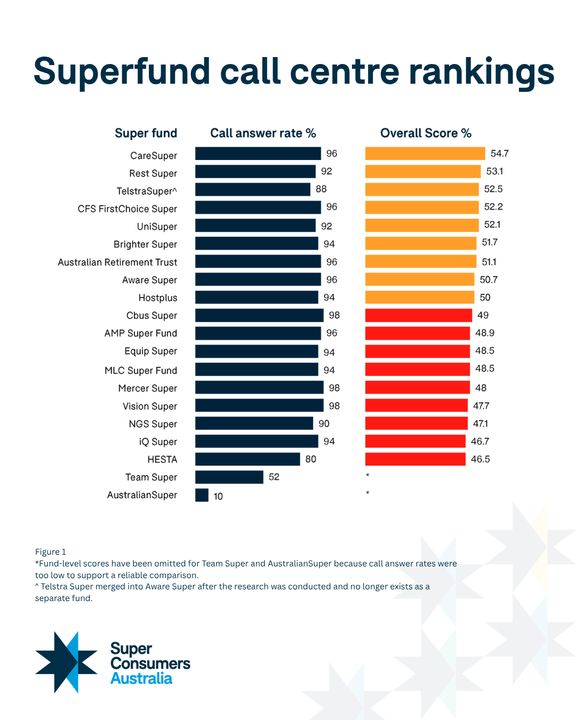
The findings weren’t great. The average customer experience score was just 49.9%. The highest fund score was only 55%. No fund came close to reaching the 80% “green zone”.
Here’s a snapshot of the overall performance of each super fund we tested. See our comparison tool for the full results.
Why customer service matters
People often call their super fund when something is unclear, stressful or urgent. They might have a question that isn’t answered on the website, they may need to make an insurance claim, access their super or try to fix an issue with their account.
Good service can help people understand their options and take the next step. Poor service can leave people confused, unsupported and unsure where to turn.
Right now, there is very little public information about the quality of service people can expect from their super fund. People can compare funds on fees and returns, but not easily on how they treat customers when they need help.
We think that needs to change.
What the pilot study tested
Mystery shopping means trained callers contact an organisation as if they are real customers, then take notes on what happened.
In this pilot, CSBA made 1,000 mystery shopper calls to 20 major super funds over a 10-week period. Each fund received 50 calls.
The calls tested three common customer service situations:
- Prospective customers: People asking questions about joining a fund.
- Culturally and linguistically diverse customers: English-speaking callers seeking information for a relative from a non-English speaking background.
- Customers experiencing vulnerability: People in difficult personal circumstances, such as family violence or financial hardship, seeking early access to their super.
The calls were assessed using a methodology CSBA has been using across industries for 10 years and counting. They call it the SenseCX methodology. This looks at more than 30 service behaviours, including whether the agent asked useful questions, took ownership of the issue, explained next steps and helped the caller understand what to do.
Importantly, none of the scenarios required the caller to complete identity verification for the agent to perform well. Agents could still score well by listening, explaining what help was available and giving clear guidance.
What the results show
Too many callers were left to work it out themselves
When people call their super fund, they should not have to know exactly what to ask or where to look next.
But the pilot found many callers were pushed back online or left without clear guidance.
- In only 8% of calls did agents clearly say they could help or take responsibility for the issue.
- In only 11% of calls did agents ask enough questions to understand what the caller needed.
- In only 7% of calls did agents clearly recap what had been discussed or explain what should happen next.
- In 23% of prospective customer calls, callers were sent back to the fund’s website instead of getting a clear answer over the phone.
In 58% of calls where someone rang on behalf of a customer with limited English, funds shifted responsibility back to the caller instead of offering direct support to the customer. Only one fund offered an interpreter option through its automated phone menu.
People should not have to become super experts, chase information across a website or rely on family members to get basic help from their fund.
People in difficult situations did not always get the support they needed
The most concerning results were for people experiencing vulnerability.
These calls involved people in difficult personal circumstances, such as family violence or financial hardship, seeking early access to their super.
We looked at empathy in a practical way. It was not about whether an agent sounded warm or friendly. It was about whether they acknowledged what the caller was going through, asked questions to understand the situation, explained what help may be available, and gave clear next steps.
Vulnerable customers had the lowest score of the three call types, at 49%. Around 70% of these calls scored 5 out of 10 or lower for empathy. The pilot also found 42% of all calls had negative sentiment.
When someone calls during grief, illness, family violence or financial hardship, they need more than a cold, transactional response. They need to be listened to, given clear information and told what they can do next.
Poor service can make an already stressful situation worse.
Getting good service was a lottery
Customer service varied widely, even within the same fund.
Individual call scores ranged from about 20% to 86%, showing that the help someone gets can depend heavily on who answers the phone.
That is not good enough. People should be able to expect a basic standard of service every time they call their super fund.
Two funds struggled to answer the phone
Across the study, 87% of calls connected within 15 minutes.
But two funds had much lower call connection rates. AustralianSuper connected only 5 out of 50 calls, or 10%, within 15 minutes. Team Super connected 26 out of 50 calls, or 52%.
Because so few calls connected, their fund-level customer experience scores were not included in the rankings. This study was mainly looking at what happens once someone gets through: whether the fund listens, explains things clearly and helps the caller understand what to do next. But people need to be able to reach their fund in the first place.
Taken together, the findings show that good customer service in super is not guaranteed, and people often have very little way of knowing what kind of help they will get until they need it.
Read our reportWhat needs to change
Customer service should be treated as part of super fund performance.
Super Consumers Australia is calling for three reforms.
1. Mandatory customer service standards
Super funds should have clear, enforceable rules for how quickly and effectively they help people.
These standards should cover phone support, clear communication, language support and help for people experiencing vulnerability.
2. Public reporting and benchmarking
Funds should have to report publicly on customer service, just as they report on investment performance.
People should be able to compare funds on service, not just fees and returns.
3. Better call centre training
Call centre staff should be trained to listen, ask useful questions, show empathy and take ownership of problems.
Funds should also make it easier for culturally and linguistically diverse customers to get help directly, including through interpreters, rather than having to rely on family members or third parties.
Learn more about our policy asksDiscover how your fund performed
You can use the pilot comparison tool to check how your fund performed in this study.
The tool lets you compare funds we tested on customer service measures, including call answer rate, ease, sentiment, success and overall customer experience.
This is not financial advice and it is not a recommendation to switch funds. There are many things to consider when choosing a super fund, including your personal circumstances.
But customer service should be part of the picture.
If your fund is not listening, explaining things clearly or helping resolve an issue, you can make a complaint and ask the fund to fix the problem.
Use our comparison toolGot a story to share? Tell us about your experience with your super fund.