

90% of retirees back performance tests for retirement products

Retirees can be left in the dark when super products perform poorly. Australians want stronger protections.
Australia’s superannuation system currently holds $4.4 trillion in retirement savings. Many Australians will rely on their super as a critical source of income in retirement.
And yet, products for people in retirement have very limited protections.
Many people who are still working have their superannuation checked by an annual performance test conducted by the Australian Prudential Regulation Authority (APRA). This test checks whether commonly used superannuation products are delivering adequate returns for members after fees and costs. If a product fails the test, its members must be notified.
When people retire, their super moves into a different category of product and the protections of the performance test disappear, even when the retirement option is the same as, or very similar to, one already being tested.
This means a retiree and someone still building their super could be invested in almost identical products, but only one is guaranteed to be warned if the product fails the performance test.
It’s unfair that retirees are left in the dark when it comes to how their investments are performing. Our research has found retirees can lose up to $205,000 by being invested in an underperforming retirement product.
Super Consumers Australia is calling for the performance test to be extended to retirement products, starting with products that are the same, or very similar, to those already being tested.
Our latest nationally representative Your Say on Super survey shows Australians agree. Most want retirement products to be independently tested, poor performance to have consequences, and clearer information to help them compare their options in retirement.
Read on to learn more about our research and what Australians want.
Key takeaways
Our analysis of APRA’s 2026 performance test results where 12 products failed the test, shows retirees are exposed to every one of them.
One was BUSSQ’s MySuper product, called Balanced Growth, which has an equivalent retirement option called Balanced Growth Pension.
Over 66,000 members invested in BUSSQ’s MySuper product will get a letter notifying them of the performance test failure. But BUSSQ is not required to give retirees invested in its equivalent option, Balanced Growth Pension, the same warning.
Many of the products already covered by APRA’s performance test are also available to retirees, but without the same protections. In 2026, 58% of choice options and 99% of platform options tested by APRA were also available in retirement.
These products are the obvious place to start extending the performance test because many are the same as, or very similar to, products APRA is already testing.
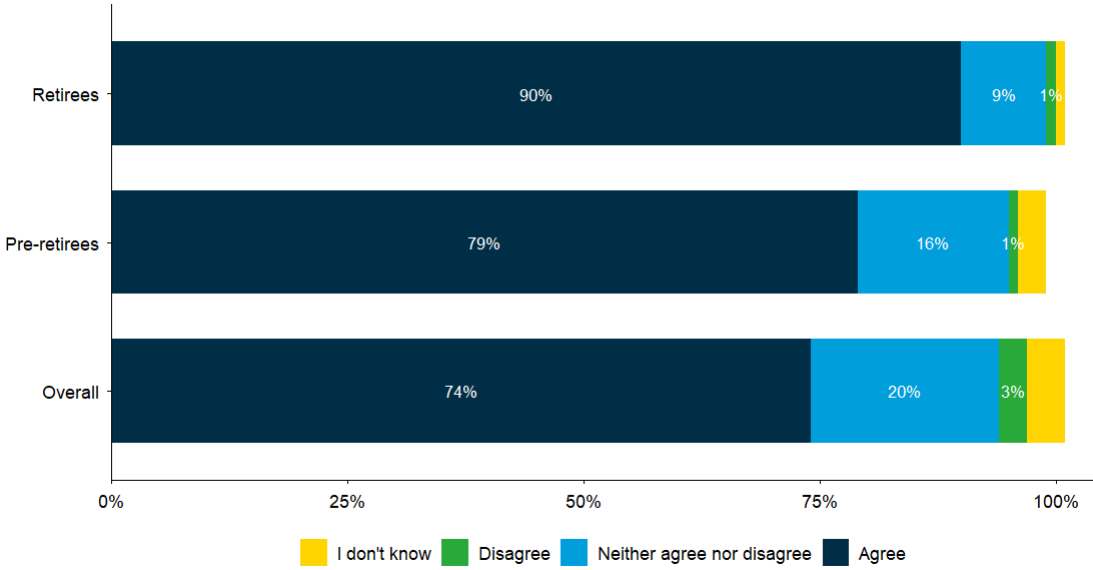
Australians support stronger accountability for retirement products. 74% agreed that retirement investment options should be subject to an independent performance test.
Support was even stronger among retirees, with 90% wanting retirement products to be tested.
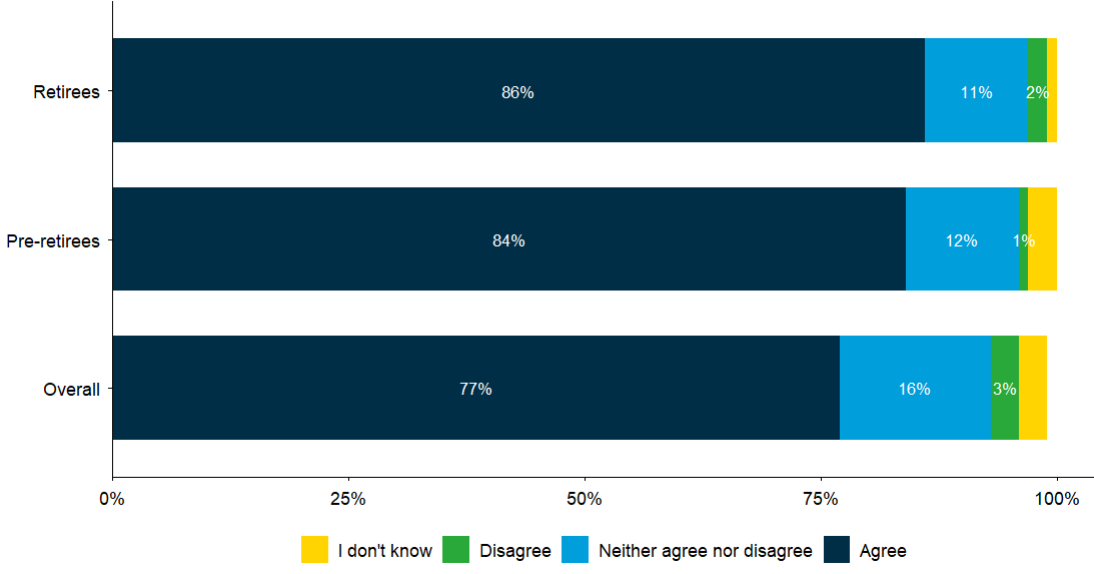
Australians also want poor performance to have consequences. 77% agreed there should be consequences if a retirement investment option underperforms, rising to 86% among retirees.
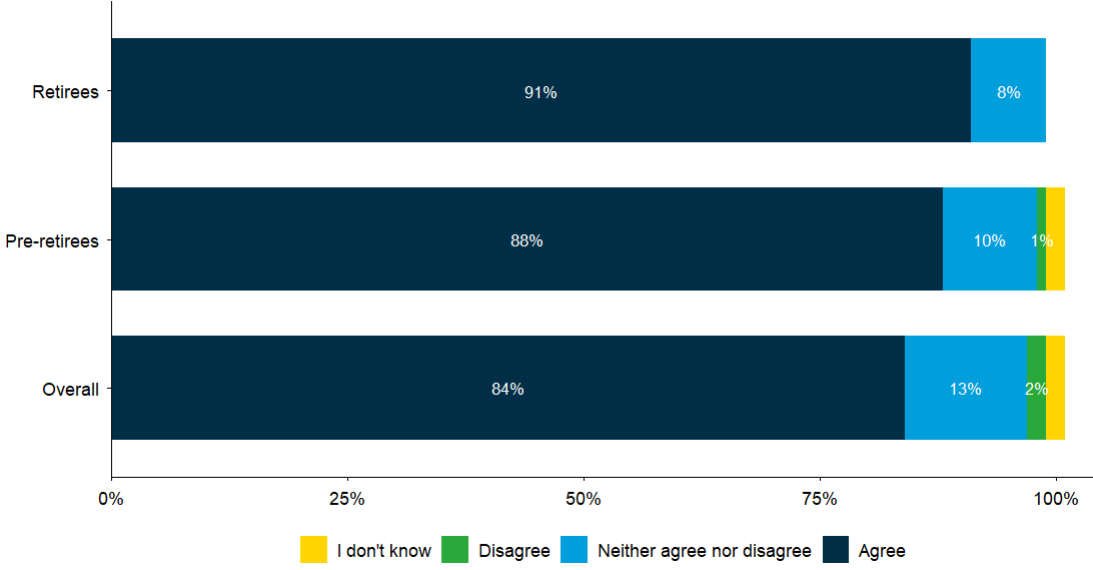
Australians want clearer information to help them compare retirement products. 84% want the government to publish information so people can compare the performance of retirement investment options.
Support was strongest among retirees, with 91% wanting published performance information to help people compare their options.
Failed products are being offered to retirees
Over the years, our analysis shows products that have failed the performance test have also been offered to retirees. But unlike people still building their super, retirees are not guaranteed to be warned when those products underperform.
Our analysis of APRA’s 2026 performance test results shows that retirees are exposed to every single one of the 12 products that failed the performance test. One of the failed products is BUSSQ’s MySuper product, Balanced Growth. BUSSQ offers an equivalent option for retirees called Balanced Growth Pension.
Over 66,000 members invested in BUSSQ’s MySuper product will get a letter notifying them of the performance test failure. But BUSSQ is not required to give retirees invested in its equivalent option the same warning.
As well as BUSSQ’s failure, 11 platform options failed the performance test. Again, investors who are still growing their super will get a warning, but retirees invested in the same or similar options may not.
12 products failed APRA’s 2026 performance test, and retirees were invested in every single one of them.
Many retirement products could be tested now
A large number of retirement products are the same as, or very similar to, products APRA is already testing. That means the performance test could be extended to many retirement products now.
Last year, we analysed APRA’s 2025 performance test results and Quarterly Superannuation Product Statistics in our report, Securing Australia’s retirement: It’s time to protect retirees from dud investment options. We found a significant overlap between products covered by the test and those available to retirees.
In 2025, 59% (301 out of 511) of choice options tested by APRA were also available to retirees. The overlap was even higher for platform options, with 99% (135 of 137) tested options also available in retirement.
Our analysis of APRA’s 2026 results shows the same pattern continues. Overall, 58% (289 out of 497) of choice options and 99% (139 out of 141) of platform options tested by APRA were also available to retirees.
58% of choice options and 99% of platform options tested in 2026 were also available to retirees.
The results show the performance test could be extended to retirement products now, starting with products that are the same as, or similar to, products already being tested.
More complex retirement products may need a tailored test, but that should not delay protections for products that can be tested now.
Retirees want more transparency and accountability
Our latest Your Say on Super survey reveals most Australians want stronger checks on retirement products, including independent performance testing, consequences for poor performance in retirement products and published results so people can compare their retirement options.
74% of Australians agreed that retirement investment options should be subject to an independent performance test.
77% of Australians agreed there should be consequences if a retirement investment option underperforms.
Pre-retirees and retirees showed the strongest support
Support for stronger retirement product protections was even higher among people approaching retirement and those already retired.
90% of retirees support applying an independent performance test to investment options designed for retirees.
These groups are more likely to face the immediate challenge of choosing, comparing and relying on retirement products.
Among pre-retirees:
- 79% supported applying an independent performance test to retirement investment options
- 84% agreed there should be consequences for underperformance
Among retirees:
- 90% supported applying an independent performance test to retirement investment options
- 86% agreed there should be consequences for underperformance
These results show people in retirement and closest to retirement are calling for stronger safeguards in a part of the super system that remains difficult to navigate.
Figure 1: Attitudes of Australians on testing performance in superannuation for retirees
Question: An independent test should be applied to investment options designed for retirees.
Question: There should be consequences if the performance of superannuation investment options designed for retirees fail.
Note: see Table 1 below for the data shown in this figure (accessible version).
Australians need better retirement product information
Choosing a retirement product is a big decision. It can affect how much income someone has for the rest of their life. As mentioned, retirees in underperforming products can lose up to $205,000 in retirement savings.
Right now, pre-retirees and retirees are expected to:
- Understand complex retirement products
- Compare investment performance across retirement options
- Work out which option is right for them and whether it is performing well
Our Your Say on Super results show strong support for better information.
84% of Australians want the government to publish information so people can compare the performance of retirement investment options.
Support was even higher among pre-retirees and retirees.
88% of pre-retirees and 91% of retirees want the government to publish information so people can compare the performance of retirement investment options.
Currently, there is no independent tool that lets people easily compare the performance of retirement products. Financial advice can help, but it is not affordable or accessible for everyone.
APRA had planned to publish more retirement product performance information in 2025–26, but this did not happen (source: APRA Corporate Plan 2025-26). This leaves Australians without a clear, independent way to compare how retirement products are performing.
Retirees should not have to hunt for information about what options are available, how they are performing, or whether they are getting a good deal. They need clear, independent information that makes it easier to compare their options and make informed decisions.
Figure 2: Attitudes of Australians on publishing performance information for retirees.
Question: The government should publish information so people can compare the performance of investment options designed for retirees.
Note: see Table 2 below for the data shown in this figure (accessible version).
What needs to happen
The Government should introduce stronger protections and clearer information for people in retirement, including:
- Extending the performance test to retirement products, starting with products that are the same as, or very similar to, those already being tested.
- Requiring clear consequences and warnings for retirees when retirement products underperform.
- Publishing independent performance information so people can easily compare retirement products.
- Developing a clear comparison tool that helps people understand how their retirement option is performing.
Australians should be able to rely on clear, independent information and basic protections when making decisions about their retirement savings.
About Your Say on Super
Your Say on Super is a recurring consumer survey run by Super Consumers Australia.
The aim is to understand how Australians experience, engage with and make decisions about their super in real life. It is a nationally representative survey that provides insights into where people need better support, clearer information and stronger protections to navigate an increasingly complex super system.These insights are used to influence policymakers and hold super funds accountable in our fight for a fair super system.
This research was supported by a philanthropic grant from Ecstra Foundation. Ecstra is committed to building the financial wellbeing of Australians within a fair financial system.Citation
Super Consumers Australia. (2026, [August, 31]). Your Say on Super: Australians want stronger protections for retirement products ( https://superconsumers.com.au/https://superconsumers.com.au/research/your-say-on-super-australians-want-stronger-protections-for-retirement-products/).
Appendix
Our methodology
This report is based on Your Say on Super, a repeated cross-sectional national survey of Australians aged 18–75.
Across all survey waves, respondents were recruited through the same online panel provider, Online Research Unit (ORU). Surveys were completed online on any internet-enabled device, and participants were financially compensated for their time.
Before each survey, a small pre-test was conducted via ORU to check question clarity and ensure survey logic and routing worked as intended.
The survey begins with screening questions, which are asked of all respondents and determine survey pathways. Participants then answer questions about their behaviours, attitudes and expectations in relation to the superannuation system. Some questions are tailored based on age, superannuation status, and whether respondents are in the accumulation phase or retired.
Respondents then complete knowledge questions assessing their understanding of key features of the super system. These questions are largely based on the Productivity Commission’s 2018 survey of super fund members. The survey concludes with demographic questions and an opportunity to provide general feedback.
To ensure data quality, responses were excluded where two or more indicators of low-quality responding were detected. This included unusually fast completion times, straight-lining, high levels of missing responses, or inconsistent answers.
To date, three survey waves have been completed:
- Pilot/benchmark survey (N = 1,559), 25 Oct–3 Nov 2022
- Second survey (N = 1,526), 14–24 May 2024
- Latest survey (N = 4,815), 7 Aug–9 Sept 2025
Accessible versions of figures
Table 1: Attitudes of Australians on testing performance in superannuation for retirees.
Question: An independent test should be applied to investment options designed for retirees.
| Group | Agree | Neither agree nor disagree | Disagree | I don’t know |
| Retirees | 90% | 9% | 1% | 1% |
| Pre-retirees | 79% | 16% | 1% | 3% |
| Overall | 74% | 20% | 3% | 4% |
Question: There should be consequences if the performance of superannuation investment options designed for retirees fail.
| Group | Agree | Neither agree nor disagree | Disagree | I don’t know |
| Retirees | 86% | 11% | 2% | 1% |
| Pre-retirees | 84% | 12% | 1% | 3% |
| Overall | 77% | 16% | 3% | 3% |
Note: This is the data shown in Figure 1. Percentages have been rounded to the nearest %. Response categories were collapsed for analysis, with ‘strongly agree’ and ‘agree’ combined into the ‘Agree’ category, and ‘strongly disagree’ and ‘disagree’ combined into a ‘Disagree’ category.
Table 2: Attitudes of Australians on publishing performance information for retirees.
Question: The government should publish information so people can compare the performance of investment options designed for retirees.
| Group | Agree | Neither agree nor disagree | Disagree | I don’t know |
| Retirees | 91% | 8% | 0% | 0% |
| Pre-retirees | 88% | 10% | 1% | 1% |
| Overall | 84% | 13% | 2% | 2% |
Note: This is the data shown in Figure 2. Percentages have been rounded to the nearest %. Response categories were collapsed for analysis, with ‘strongly agree’ and ‘agree’ combined into the ‘Agree’ category, and ‘strongly disagree’ and ‘disagree’ combined into a ‘Disagree’ category.