

Most people expect faster service from super funds

We asked people across Australia how long they think six common super fund payments should take. For simpler, straightforward payments, available data suggests super funds are delivering within the timeframes people expect. But when illness, disability or death leaves people waiting for urgently needed money, we expect funds to act much faster than they currently do.
On this page
How long should it take to get money from your super fund?
In our latest Your Say on Super survey, we asked 4,815 people across Australia how long they thought super funds should reasonably take to pay or transfer money in the following six scenarios:
- Taking a lump sum out of your super after retiring
- Accessing super early when you are struggling to cover living costs
- Moving your super to a new fund
- Claiming income protection insurance when illness stops you working
- Claiming total and permanent disability (TPD) insurance when you can no longer work
- Claiming a loved one’s death benefit (super and any life insurance) after they die
We found that while funds were generally meeting expectations for simpler payments, big ticket payouts were taking far longer than people thought was reasonable. Older and retired people, people who speak a language other than English at home and women believed that payments should be faster than the general population.
People rely on their super at some of life’s most difficult moments, when people may already be dealing with disability, grief and financial pressure. At times like these, people need certainty about when their super fund will pay them.
That is why Super Consumers Australia is calling on the Australian Government to introduce mandatory end-to-end timeframes for key payments, so people aren’t left stranded when they need support most. We also want all funds to publish comparable information about their service performance, so people can see how long payments take and how their fund stacks up.
Read on for a closer look at what our research found.
Figure 1: Super payments report card – How consumer expectations compare with reality
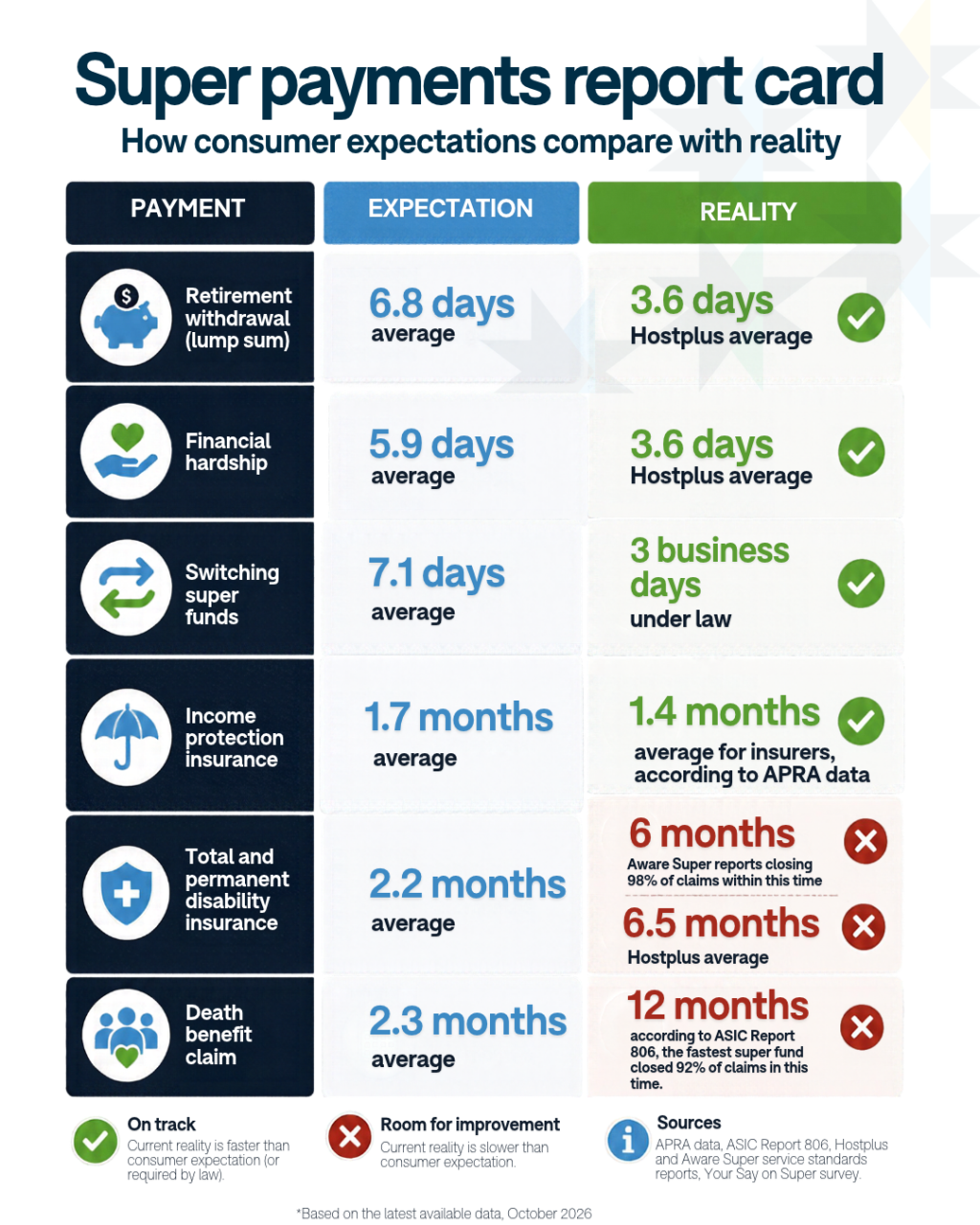
Note: See Table 1 below for the data shown in this figure (accessible version).
We compared people’s expectations about how fast a payment should take with what happens in practice. We reviewed current legal requirements, industry commitments, the timeframes funds estimate and, where available, data showing how long payments actually took.
Funds are not required to report their processing times consistently, and only a small number, including Hostplus and Aware Super, publish performance data. This means there is no complete industry-wide picture. Available sources may also measure different stages of the process or exclude certain claims. We explain these qualifications in the insights below.

Key takeaways
People think it is reasonable for funds to take on average:
- 7 days to make a lump-sum retirement withdrawal
- 6 days to make a financial hardship payment
- 7 days to move their super another fund
Available data suggests these timeframes are close to what funds currently deliver.
People who responded to the survey allowed more time for complex claims, but still expected funds to act within a few months on average:
- 1.7 months for an income insurance claim
- 2.2 months for a TPD insurance claim
- 2.3 months for a death benefit claim
When it comes to income protection insurance, available data suggests these timeframes are close to what insurers currently deliver, although super fund processing can add several weeks on top of the time insurers are taking.
But, when it comes to TPD and death benefit claims, actual waiting time is much longer than expected. TPD claims can take around 6 months, while ASIC found that many death benefit claims were still open after 12 months (source: ASIC Report 806).
People who are retired, aged 65 and over, said it was reasonable for funds to take:
- 1.3 months to pay an income protection claim, compared with 1.7 months overall
- 1.5 months to pay a TPD insurance claim, compared with 2.2 months overall
- 1.9 months to pay a death benefit claim, compared with 2.3 months overall
People who speak other languages said it was reasonable for funds to take:
- 5 days to make a financial hardship payment, compared with 6 days overall
Women said it was reasonable for funds to take:
- 1.9 months to pay a TPD insurance claim, compared with 2.4 months for men
About this research
We asked people to tell us what they thought a reasonable end-to-end timeframe was for six common payments. End-to-end means from the date you first contact the fund to the date of payment.
We asked people about their end-to-end expectations because that’s the best measure of someone’s actual experience of how long it takes to get their money. Most super funds don’t measure end-to-end: they often start the clock when they receive a completed application form. That means funds don’t count:
- The time it took them to send you the form
- How long it took you to figure out what the form was asking for
- How long it took you to get all the information they wanted.
We’re advocating for mandatory end-to-end timeframes for super funds to process payments and a requirement to prioritise the needs of people experiencing vulnerability.
Insight 1: People expect simpler payments within a week
People said it was reasonable for funds to take on average:
- 7 days to make a lump-sum retirement withdrawal
- 6 days to make a financial hardship payment
- 7 days to move a balance to another super fund
How long should it take?
There are no rules about how fast retirement and hardship payments should be made. We looked online and found that some funds say they will take 3 to 10 business days for a retirement withdrawal and 5 days for financial hardship.
Funds are required by law to process a rollover from one fund to another within 3 business days of receiving a completed application (source: Superannuation Industry (Supervision) Regulations 1994, r 6.34A). This can mean 5 calendar days when a weekend is included or 6 days when there is a Monday public holiday. This timeframe does not include the time that the new super fund may take to set up a new account and allocate your money to it.
How long does it actually take?
Hostplus Super is one of the few funds that publicly reports on their service times. They reported it took them an average of 3.6 days to make retirement and hardship payments in the quarter ending 31 March 2026 from receipt of a completed application to payment (source: Hostplus Service Standards Report, March 2026).
We couldn’t find any information about how long super switches are actually taking.
Assuming the application forms don’t take too long to complete, on the whole, it looks like super funds are probably close to meeting people’s expectations about how long simple payments should take.
Figure 2: Average timeframes people expect for simpler payments from their super fund
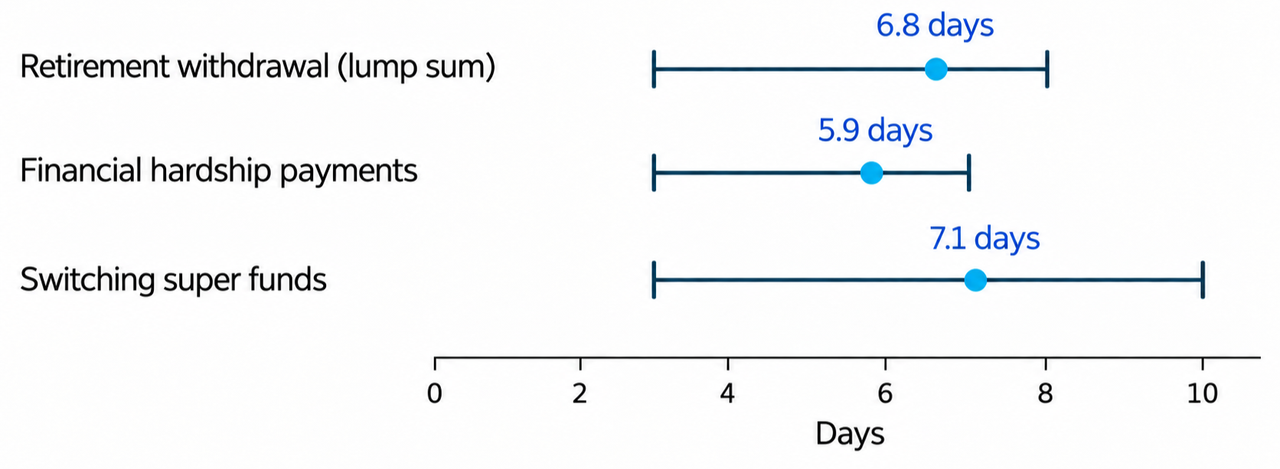
Note 1: See Table 2 for the data shown in this figure (accessible version).
Note 2: The blue dot represents the average expected time for each payment. The horizontal lines show the range of the middle 50% of responses (from the 25th to the 75th percentile).
Insight 2: TPD insurance and death benefit claims can take much longer than people expect
People across Australia allowed more time for complex claims, including income protection, TPD and death benefit claims. But TPD and death benefit claims often take much longer than people consider reasonable.
Income protection
What is income protection insurance?
People make income protection insurance claims when they are unable to work for a period of time, for example due to a serious illness. Income protection insurance replaces a portion of your salary while you’re off work so you have some money to cover your expenses.
People said 1.7 months was a reasonable amount of time to start receiving income protection payments.
How long should it take?
There are no rules for how fast an income protection insurance claim should take, but insurers have committed to deciding claims within 6 months of receiving them from the super fund (source: March 2025 Life Insurance Code of Practice). However, the Code used to promise 2 months (source: December 2023 Life Insurance Code of Practice).
How long does it actually take?
APRA data shows insurers took 1.4 months on average during the period of 1 July 2025 to 30 June 2026. However, this excludes processing by the super fund, such as the time that the super fund spends sending you forms to fill out, verifying your identity, assessing eligibility and processing payment. End-to-end processing times likely take closer to 2-3 months.
TPD insurance
What is TPD insurance?
TPD insurance pays you a lump sum if an illness or injury leaves you permanently unable to work. This money can help with living costs, medical care, home changes and one‑off expenses. To make this kind of insurance claim, you usually need a lot of medical evidence to prove you can’t work anymore. Because of this, TPD claims usually take longer than income protection claims, which require less medical evidence.
People said 2.2 months was reasonable for a TPD insurance claim payout.
How long should it take?
There is no mandatory end-to-end timeframe for TPD claims. Insurers have committed to deciding these claims within 6 months of receiving them from the fund (source: March 2025 Life Insurance Code of Practice).
How long does it actually take?
APRA data for the period of 1 July 2025 to 30 June 2026 shows insurers actually took 3.7 months on average. But again, this excludes time the fund spends processing your claim, which might double the processing time.
Hostplus Super reported it took them an average of 199 days (6.5 months) to make TPD payments in the quarter ending 31 March 2026 from receipt of a completed application to payment (source: Hostplus Service Standards Report, March 2026).
Aware Super also published handling times for TPD claims. It says that it processed 98% of claims within 180 days (6 months). However, it excluded claims that took longer due to “probity, incomplete or inaccurate information or difficulties contacting all beneficiaries” (source: Aware Super Member Service Standards Report, September 2025).
The average end-to-end processing times across all super funds is likely to be more than 6 months. This is considerably longer than the 2.2 months people expect.
Death benefits
What is a death benefit?
A death benefit is money paid from someone’s superannuation account after they die. It includes their account balance and any life insurance they had. This money is usually paid to their family or to their estate. Processing an insurance claim when someone passes away is pretty simple because the insurance company usually only needs a death certificate to confirm the person has passed away. Most of the work is done by the fund to work out who to pay the money to.
People said 2.3 months was reasonable for a death benefit payout. In 2025, ASIC found many death benefit claims were still open after 12 months. There is a massive difference between the consumer expectation of 2.3 months and the reality of more than 12 months.
How long should it take?
There is no mandatory timeframe for processing death benefit claims. Super funds are required to pay death benefits “as soon as practicable” but the law does not give a clear deadline for payment (source: Superannuation Industry (Supervision) Regulations 1994, r 6.21(1)).
How long does it actually take?
ASIC looked at the end-to-end processing times for ten funds over a two year period ending 31 March 2024 (source: ASIC REP 806). It found that the fastest fund closed 92% of its claims in 360 days (12 months) and 48% of its claims in 90 days (3 months). The slowest fund closed only 84% of its claims in 360 days (12 months) and just 8% in 90 days (3 months).
ASIC’s 2026 follow up review found only modest progress, with the proportion of claims closed within 6 months increasing by just 3% (source: ASIC REP 831).
Figure 3: Average timeframes people expect for more complex payments from their super fund.
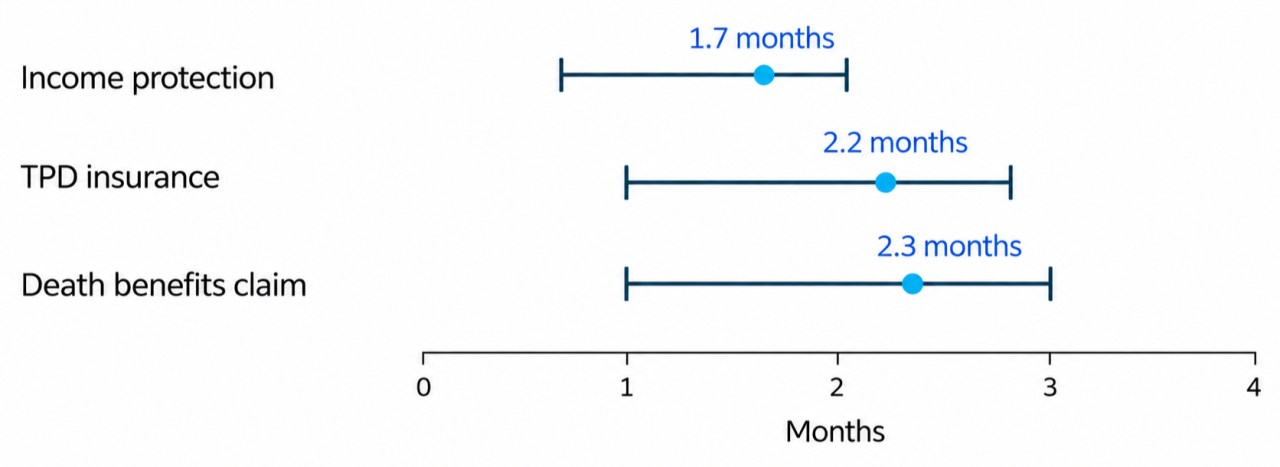
Note 1: See Table 3 for the data shown in this figure (accessible version).
Note 2: The blue dot represents the average expected time for each payment. The horizontal lines show the range of the middle 50% of responses (from the 25th to the 75th percentile).
Insight 3: Some groups expect faster processing times
What is ‘reasonable’ to wait for a payment from your super fund depends on external factors like your personal circumstances, but also demographics. Funds need to consider and understand the different needs of their members if they want to provide them with quality service.
People who speak other languages
People across the survey expected financial hardship payments one day faster than retirement withdrawals or super switches (at 6 days on average compared with 7 days on average). This is probably because most people understand that people in financial hardship need money faster.
However, people who speak a language other than English at home expected financial hardship withdrawals to take even less time at 5 days on average.
Older people and retirees
Age was also a significant predictor of how long people thought it was reasonable to wait for a payment. People on average thought it was reasonable for it to take about 7 days on average to process a lump sum withdrawal from a retirement account. But if they were retired and over the age of 65, they thought it should only take about 6 days on average. This likely reflects the fact that retirees rely on these payments to meet expenses.
The same was true for insurance claims. People who are retired, aged 65 and older, on average thought it was reasonable to take:
- 1.3 months for an income protection claim should take compared with 1.7 months for all respondents.
- 1.5 months for a TPD claim compared with 2.2 months for all respondents.
- 1.9 months for a death benefit claim compared with 2.3 months for all respondents.
Women
Unlike the other payments, there was a significant difference between women and men for TPD claims. Whereas women on average thought 1.9 months was reasonable, men were okay waiting a bit longer. On average, men felt 2.4 months was reasonable.
How long should it take?
There is no legal requirement to prioritise payments for people experiencing vulnerability. ASIC observed in its death benefits review that while most funds in their review had vulnerable customer policies, they varied in quality (source: ASIC REP 806). Funds also varied greatly in how much assistance they provided to people experiencing financial hardship. Some funds would make substantial early part payments to people and others only tried to process the claim faster.
Few funds provide information on their websites about their policies or what assistance is available. The lack of public information makes it difficult for people experiencing vulnerability to know they can ask for help.
What needs to happen
Set maximum processing timeframes
People should know when their super fund will pay them. Available data shows funds are falling short of expectations when it comes to TPD insurance and death benefit claims.
The Government should set mandatory end-to-end processing timeframes for all key payments. People should be able to take action when funds miss these deadlines, and the Australian Financial Complaints Authority (AFCA) should be able to award compensation for unreasonable delays.
Require uniform public performance reporting
The Government should require every fund to report the same service performance data, so people can clearly see how each fund performs.
Currently, most funds do not publish their processing times at all. Hostplus and Aware Super are among the few that voluntarily report this information.
The data that is available is difficult to compare. Funds start measuring at different points or exclude certain claims making processing times look faster than they are.
Prioritising people experiencing vulnerability
The Government has committed to introducing mandatory customer service standards. These standards should require funds to have clear policies for supporting people experiencing vulnerability and publish information about the additional help available.
While most funds offer to process claims faster when someone is in need, support often depends on staff recognising the need, or the person asking for help they may not know exists. Funds should be required to proactively identify and flag vulnerability, rather than relying on people to disclose their circumstances or find support themselves.
About Your Say on Super
Your Say on Super is a recurring consumer survey run by Super Consumers Australia. The aim is to understand how Australians experience, engage with, and make decisions about their super in real life. It is a nationally representative survey that provides insights into where people need better support, clearer information and stronger protections to navigate an increasingly complex super system. These insights are used to influence policymakers and hold super funds accountable in our fight for a fair super system.This research was supported by a philanthropic grant from Ecstra Foundation. Ecstra is committed to building the financial wellbeing of Australians within a fair financial system.
Citation
Super Consumers Australia. (2026, October 20). Most people expect faster service from super funds (https://superconsumers.com.au/research/most-people-expect-fast-service-from-super-funds/).
Appendix
Our methodology
This report is based on Your Say on Super, a repeated cross-sectional national survey of Australians aged 18–75.
Across all survey waves, respondents were recruited through the same online panel provider, Online Research Unit (ORU). Surveys were completed online on any internet-enabled device, and participants were financially compensated for their time.
Before each survey, a small pre-test was conducted via ORU to check question clarity and ensure survey logic and routing worked as intended.
The survey begins with screening questions, which are asked of all respondents and determine survey pathways. Participants then answer questions about their behaviours, attitudes and expectations in relation to the superannuation system. Some questions are tailored based on age, superannuation status, and whether respondents are in the accumulation phase or retired.
Respondents then complete knowledge questions assessing their understanding of key features of the super system. These questions are largely based on the Productivity Commission’s 2018 survey of super fund members. The survey concludes with demographic questions and an opportunity to provide general feedback.
To ensure data quality, responses were excluded where two or more indicators of low-quality responding were detected. This included unusually fast completion times, straight-lining, high levels of missing responses, or inconsistent answers.
To date, three survey waves have been completed:
- Pilot/benchmark survey (N = 1,559), 25 Oct–3 Nov 2022
- Second survey (N = 1,526), 14–24 May 2024
- Latest survey (N = 4,815), 7 Aug–9 Sept 2025
Survey questions
The text below is the actual text that people who responded to the survey were asked. For each question, people could use a slider bar to indicate the number of days or months they thought was reasonable to process each request or claim. Participants were also given the option to enter in a value manually. Across the scenarios, an average of 1.3% of people chose to manually enter a value rather than use the sliding scale.
For each of the following scenarios, please tell us how long you think it should reasonably take for a super fund to make a payment. Please answer based on what you believe is a reasonable amount of time, not on what you think currently happens or what the typical time-frames might be. There is no wrong answer.
In your opinion, what is a reasonable amount of time for a super fund to pay the requested payment/benefit, after you first contact them about making the request or claim, in each of the following scenarios?
a) You are retired and eligible to withdraw money from your super fund. You want to request a lump sum payment from your super.
b) You are going through a tough time financially and are struggling to cover your living costs. You want to make a request to your super fund to take out some of your super early to help pay for living expenses.
c) You decide to change super funds. You want to request your super balance to be moved to your new fund.
d) You have a temporary medical condition and cannot work for a year while you recover. You are eligible to claim insurance through your super which will cover some of your wages while you are unable to work. You want to make a claim for this money. (Income protection or IP insurance.)
e) You become totally and permanently disabled and can never return to work. You are eligible to claim insurance through your super which will pay a lump sum benefit to cover your living costs. You want to make a claim for this money. (Total and Permanent Disability or TPD insurance.)
f) You have recently lost a close family member. You are eligible to claim their remaining super, including any insurance. You want to make a claim for this money. (Death benefit.)
Accessible tables
Table 1: Super payments report card – How consumer expectations compare with reality
| Payment | Expectation | Reality |
| Retirement withdrawal (lump sum) | 6.8 days average | 3.6 days Hostplus average |
| Financial hardship | 5.9 days average | 3.6 days Hostplus average |
| Switching super funds | 7.1 days average | 3 business days under law |
| Income protection insurance | 1.7 months average | 1.4 months average for insurers according to APRA data |
| Total and permanent disability insurance | 2.2 months average | 6 months Aware Super reports closing 98% of claims within this time 6.5 months Hostplus average |
| Death benefit claim | 2.3 months average | 12 months according to ASIC report 806, the fastest super fund closed 92% of claims in this time |
Note: This is the data shown in Figure 1.
Table 2: Average timeframes people expect for simpler payments from their super fund
| Scenario | First Quartile (Q1) | Average | Median | Third Quartile (Q3) |
| Retirement withdrawal (lump sum) | 3.0 days | 6.8 days | 7.0 days | 8.0 days |
| Financial hardship payments | 3.0 days | 5.9 days | 5.0 days | 7.0 days |
| Switching super funds | 3.0 days | 7.1 days | 7.0 days | 10.0 days |
Note: This is the data shown in Figure 2.
Table 3: Average timeframes people expect for more complex payments from their super fund
| Scenario | First Quartile (Q1) | Average | Median | Third Quartile (Q3) |
| Income protection | 0.7 months | 1.7 months | 1.0 month | 2.0 months |
| TPD insurance | 1.0 month | 2.2 months | 1.0 month | 2.8 months |
| Death benefit claim | 1.0 month | 2.3 months | 1.8 months | 3.0 months |
Note: This is the data shown in Figure 3.